
Rajdeep IVF
on 3 weeks ago
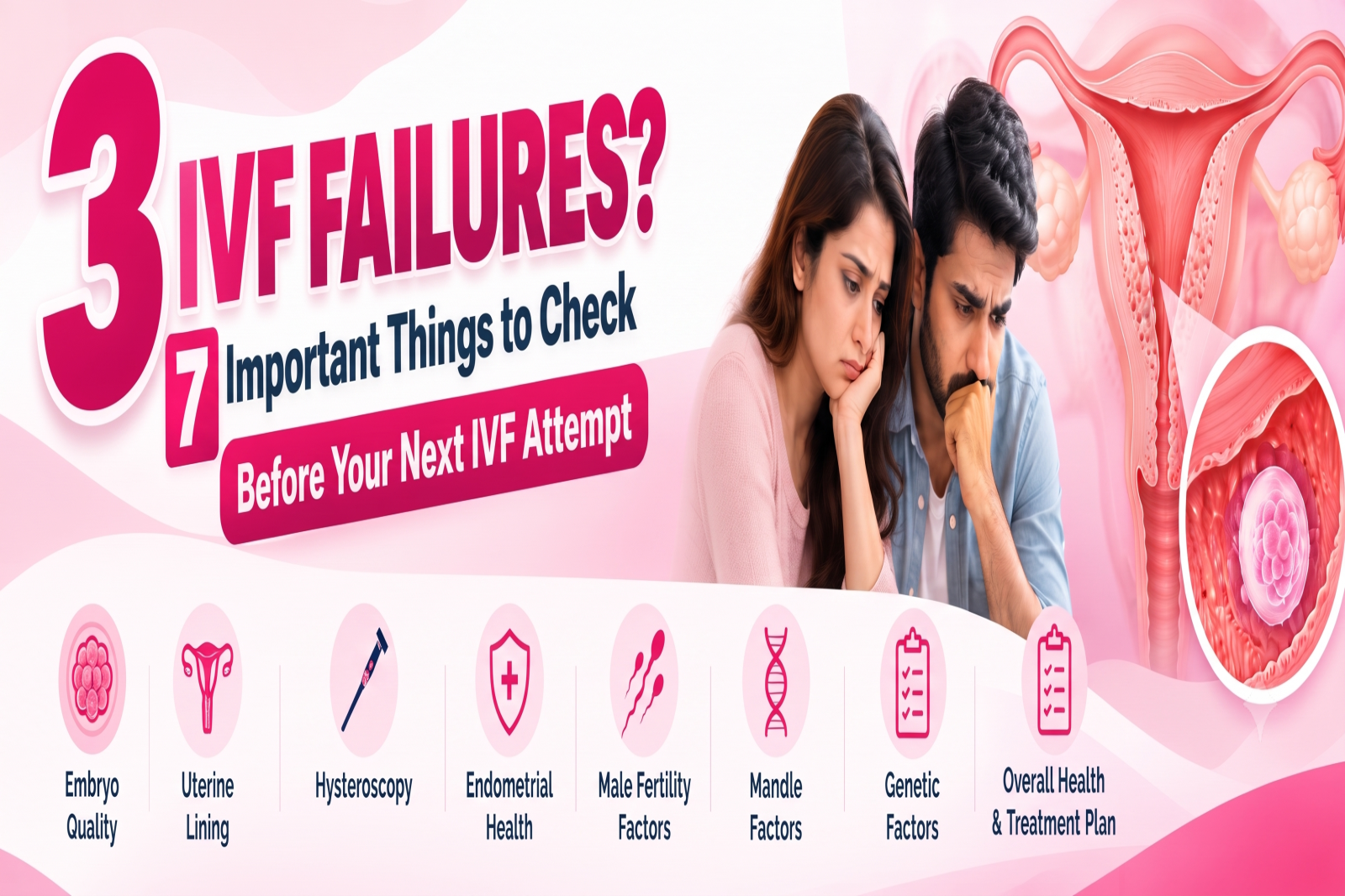
3 IVF Failures? 7 Important Things to Check Before Your Next IVF Attempt
3 IVF Failures? Don't Rush Into Another IVF Cycle
Experiencing one unsuccessful IVF cycle can be emotionally and financially difficult. When IVF has failed multiple times, many couples naturally ask: “What went wrong?” and “What should we check before trying again?”
The answer is not always one single factor. Implantation and pregnancy involve the embryo, uterus, endometrium, hormonal environment, sperm and several other factors.
It is also important to distinguish between three unsuccessful IVF cycles and recurrent implantation failure (RIF). Not every failed IVF cycle means that a patient has RIF. Current American Society for Reproductive Medicine (ASRM) guidance recommends defining RIF based on the number and quality of blastocysts transferred and the expected cumulative chance of implantation, rather than simply counting IVF cycles.
If IVF has failed repeatedly, a detailed review of previous treatment cycles can help a fertility specialist decide what, if anything, needs further evaluation before another embryo transfer.
Here are 7 important areas to discuss with your fertility specialist.
1. Review Your Previous IVF Cycles and Embryo Quality
Before starting another cycle, your doctor may first review what happened during the previous treatments.
This can include:
- Number of eggs retrieved
- Number of mature eggs
- Fertilization rate
- Number and quality of embryos
- Blastocyst development
- Fresh or frozen embryo transfer
- Embryo grading
- Endometrial thickness
- Progesterone and other relevant hormonal factors
- Details of previous embryo transfers
- Pregnancy test results following transfer
The embryo itself is an important part of implantation. Age-related chromosomal abnormalities (aneuploidy) are considered a major contributor to implantation failure, particularly as maternal age increases.
In selected patients with repeated implantation failure and previously untested embryos, PGT-A may be discussed as part of shared decision-making. However, it is not a universal solution and current ASRM guidance does not conclude that PGT-A increases live-birth rates specifically in patients with RIF.
2. Check the Uterus and Uterine Lining
One of the most important areas to evaluate after repeated implantation problems is the uterine cavity and endometrium.
Think of the embryo as a seed and the uterine lining as the environment in which implantation needs to occur. A good-quality embryo still needs a suitable uterine environment for implantation.
Doctors may evaluate for conditions such as:
- Endometrial polyps
- Submucosal fibroids
- Intrauterine adhesions
- Uterine structural abnormalities
- Adenomyosis
- Hydrosalpinx
- Other abnormalities affecting the uterine cavity
ASRM's 2026 guidance states that, when RIF is suspected, assessment of the endometrial cavity can include saline sonohysterography, hysteroscopy or 3D ultrasound, depending on the patient's circumstances.
3. Consider Hysteroscopy When Appropriate
Hysteroscopy allows a doctor to directly examine the inside of the uterus using a small camera.
It can help identify abnormalities that may not always be obvious on routine evaluation, including:
- Polyps
- Submucosal fibroids
- Intrauterine adhesions
- Other abnormalities inside the uterine cavity
An additional advantage is that certain abnormalities can potentially be treated during the same procedure.
However, hysteroscopy should not automatically be considered necessary for everyone after an IVF failure. Its usefulness depends on the patient's history, previous investigations and clinical findings. ASRM notes that repeat uterine-cavity evaluation can reasonably be considered in patients with RIF, particularly when there are concerns such as inadequate endometrial thickness or other clinical indications.
4. Look for Endometrial or Inflammatory Problems
In some patients with repeated implantation failure, doctors may consider whether chronic endometritis or another uterine inflammatory condition could be contributing.
Chronic endometritis is an inflammation of the endometrium that can sometimes be evaluated using an endometrial biopsy, with additional laboratory or histological assessment depending on the clinical situation.
Hysteroscopy may also provide useful information about the uterine cavity.
The evidence surrounding chronic endometritis is still developing, so testing and treatment should be based on the individual patient's history rather than routinely performed in every IVF patient. ASRM's 2026 review notes some observational evidence for evaluation and treatment in RIF but also highlights limitations in the available evidence.
5. Don't Ignore Male Fertility Factors
IVF is often discussed mainly in terms of the woman's reproductive health, but male factors also contribute to infertility.
Depending on the history, doctors may review:
- Semen analysis
- Sperm count
- Sperm motility
- Sperm morphology
- Previous fertility investigations
- Relevant medical or lifestyle factors
Not every advanced sperm test is automatically useful after IVF failure. For example, ASRM's 2026 RIF guidance says there is currently insufficient evidence to routinely recommend sperm DNA fragmentation testing specifically for RIF.
The right approach is therefore to evaluate both partners rather than assuming that repeated IVF failure is automatically caused by the woman.
6. Review Genetic Factors and Whether Additional Testing Is Appropriate
Genetic factors can sometimes contribute to implantation failure or pregnancy loss.
Depending on the couple's medical and reproductive history, a fertility specialist may consider:
- Genetic counselling
- Parental karyotyping in selected situations
- Embryo genetic testing discussions
- Review of previous pregnancy or implantation outcomes
For patients with RIF and untested embryos, PGT-A may be considered in a shared decision-making approach, but it should not be presented as a guaranteed solution for repeated IVF failure. ASRM specifically notes that current evidence does not show that PGT-A increases live birth rates for patients with RIF.
7. Review Your Overall Health and IVF Treatment Plan
Before another IVF attempt, your doctor may also review your overall health and the treatment protocol used previously.
This may include:
- Thyroid health when clinically indicated
- Diabetes or blood-sugar control
- Weight and nutritional status
- Smoking or tobacco use
- Alcohol and recreational drug use
- Medications
- Previous ovarian stimulation protocol
- Embryo-transfer strategy
- Hormonal preparation for frozen embryo transfer
A healthy lifestyle is important for general reproductive and pregnancy health. ASRM recommends addressing general health factors and avoiding smoking, tobacco and illicit drugs before pregnancy attempts.
At the same time, patients should be cautious about undergoing a long list of expensive tests simply because IVF has failed. More testing does not automatically mean better treatment.
ASRM's 2026 guidance emphasizes a comprehensive review of the patient's reproductive history, IVF details and available investigations, while noting that extensive testing is unnecessary when there is no clear indication.
What About ERA, Immune Tests and Other "Advanced" Tests?
After repeated IVF failure, couples may come across many tests and treatments marketed as ways to improve implantation.
These can include:
- Endometrial receptivity tests
- Endometrial scratching
- Immune testing
- IVIG
- Heparin or Lovenox without a clear indication
- G-CSF
- Sperm DNA fragmentation testing
These tests and treatments are not automatically recommended for every patient with repeated IVF failure.
The latest ASRM guidance states that several of these interventions do not currently have sufficient evidence to support routine use in RIF.
That is why it is important to ask your fertility specialist:
“Why is this test recommended for me, and how will the result change my treatment?”
What Should You Do After 3 IVF Failures?
There is no single checklist that applies to every couple.
Instead, your fertility specialist should ideally review:
Previous IVF cycles → Embryo development → Uterine cavity → Endometrium → Relevant medical conditions → Male factors → Genetic considerations → Previous transfer outcomes
Based on these findings, the doctor can decide whether another embryo transfer, additional evaluation or a change in treatment strategy is appropriate.
The goal should not simply be to repeat the same IVF cycle again. The goal is to understand whether there is an identifiable and potentially correctable factor before moving forward.
Final Thoughts
Three unsuccessful IVF attempts do not necessarily mean that pregnancy is impossible. At the same time, repeated failure deserves a careful and individualized evaluation rather than simply repeating treatment without reviewing what happened previously.
The uterus, endometrium, embryo, sperm factors, genetics, medical history and treatment protocol may all need to be considered.
If you have experienced repeated IVF failure, speak with a qualified fertility specialist and discuss which evaluations are actually appropriate for your specific situation.
Every fertility journey is different. The right next step depends on your individual medical and reproductive history.
About Rajdeep Fertility Research & IVF Centre
At Rajdeep Fertility Research & IVF Centre, fertility care involves evaluating the individual needs of each couple and developing a treatment approach based on their medical history and fertility assessment.
If you have experienced repeated IVF failure, consult a fertility specialist before planning your next attempt.


POST COMMENT
For post a new comment. You need to login first. Login
COMMENTS(0)
No Comment yet. Be the first